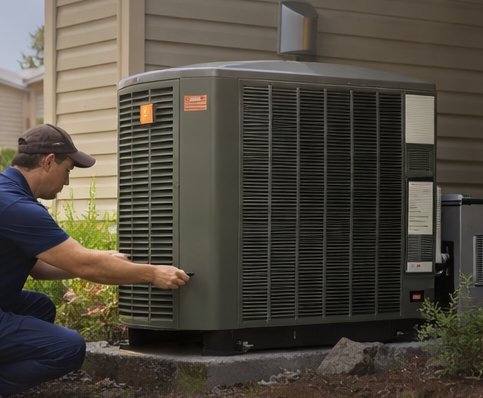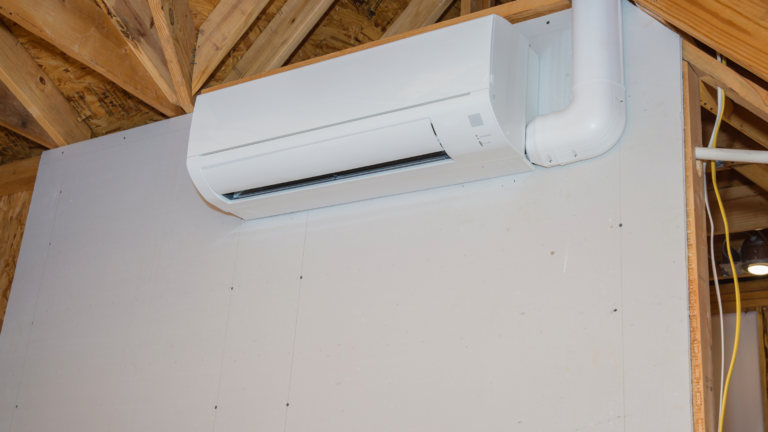

Installing an air-source heat pump at 8,000 feet is not the same as installing the same equipment at sea level. For contractors and homeowners in high-elevation areas, this creates an important equipment-sizing question: How much heating capacity will a heat pump actually have after accounting for both cold outdoor temperatures and elevation?
This matters throughout the Colorado mountains, where elevations of 7,000–10,000 feet are common andwinter design temperatures can fall well below 0°F. Modern cold-climate heat pumps can operate atextremely low outdoor temperatures, but the lowest temperature at which a heat pump can operate is notnecessarily the most important number when sizing the system. What matters is whether the equipmentcan produce enough heat to satisfy the building’s calculated heating load at the local winter designcondition.
Elevation adds another variable because air becomes less dense as altitude increases.
Start With the Home, Not the Heat Pump
Before choosing equipment, the first step is determining how much heat the home actually requires. This is done with a Manual J load calculation. Manual J looks at the characteristics of the individual home, including insulation, windows, air leakage, orientation, construction, square footage, and local weather conditions.
The result gives an estimated heating and cooling load for the building.
For example, a Manual J calculation might determine that a home requires 15,000 BTU/h of heating at a
−10°F winter design temperature. For the examples in this article, −10°F is used because that is the winter design temperature for Chaffee County, Colorado, where Valley Ductless is based.
That calculated heating load becomes the target. Manual J tells us what the home needs, while manufacturer performance data tells us what the heat pump can provide. The goal during equipment selection is to make sure those two numbers work together.
Manual J determines the heating and cooling load of the home, while ACCA Manual S provides the framework for selecting equipment to meet that load. Manual S is used as part of the equipment-selection process, along with manufacturer-specific performance data and high-altitude guidance. At high elevations, manufacturer data is especially valuable because it allows the system’s expected performance to be evaluated under the actual conditions where it will be installed.
What Does a −10°F Design Temperature Actually Mean?
There’s an important distinction here that is easy to misunderstand. A −10°F winter design temperature does not mean −10°F is the coldest temperature Chaffee County will ever experience. Temperatures can absolutely fall below the design temperature, including occasional periods of −15°F, −20°F, or even colder conditions.
HVAC design temperatures are statistical conditions used for equipment sizing. They represent temperatures that a heating system is expected to encounter during the vast majority of the heating season rather than the coldest temperature ever recorded. That’s intentional. If every heating system were sized around the most extreme temperature that has ever occurred, the result would often be significantly oversized equipment for nearly the entire heating season.
So when a heat pump is sized to meet the home’s heating load at −10°F, it is being designed to meet the calculated load at the area’s established winter design condition. During an unusually severe cold snap below that temperature, the home’s heat loss will continue increasing. Depending on the system, supplemental heat may become helpful or necessary during those relatively uncommon conditions.
That doesn’t mean the heat pump was sized incorrectly. It simply means outdoor temperatures have moved beyond the conditions the system was designed around.
Why High Elevation Matters
Cold temperature isn’t the only challenge in the mountains. Elevation matters too. As elevation increases, atmospheric pressure and air density decrease.
That’s important for an air-source heat pump because the system exchanges heat with air on both sides of the refrigeration cycle. During heating operation, the outdoor coil extracts heat from outdoor air. The refrigeration system moves that energy indoors, and the indoor coil transfers it into the home. At high elevation, the same volume of air contains less mass than it does at sea level.
Mitsubishi Electric specifically addresses this issue in Application Note 1021: M&P Series High Altitude Applications. Mitsubishi states that decreased air density at higher elevations reduces operating capacity and that equipment may need to be sized accordingly to meet the building load.
One particularly interesting part of Mitsubishi’s guidance is that the indoor and outdoor sides of the heat pump are not treated the same way.
Mitsubishi’s High-Elevation Capacity Corrections
Mitsubishi publishes separate correction factors for indoor and outdoor units:
| Elevation | Indoor Unit Factor | Outdoor Unit Factor |
| Sea Level | 1.00 | 1.00 |
| Elevation | Indoor Unit Factor | Outdoor Unit Factor |
| 1,000 ft | 0.96 | 0.99 |
| 2,000 ft | 0.93 | 0.98 |
| 3,000 ft | 0.90 | 0.98 |
| 4,000 ft | 0.86 | 0.97 |
| 5,000 ft | 0.83 | 0.96 |
| 6,000 ft | 0.80 | 0.95 |
| 7,000 ft | 0.77 | 0.94 |
| 8,000 ft | 0.74 | 0.94 |
| 9,000 ft | 0.71 | 0.93 |
| 10,000 ft | 0.69 | 0.92 |
At approximately 8,000 feet, Mitsubishi uses an indoor correction factor of 0.74 and an outdoor correction factor of 0.94. That’s a significant difference, and it shows why using a blanket statement such as “heat pumps lose X percent of their capacity for every 1,000 feet of elevation” can be misleading.
The actual situation is more complicated than that. Mitsubishi’s published data shows that the indoor and outdoor sides can be affected very differently, and its sizing guidance accounts for that.
A “24,000 BTU” Heat Pump Isn’t Always Producing 24,000 BTUs
This is another area where heat-pump terminology can be confusing. A heat pump might commonly be referred to as a 24,000 BTU, or “24k,” system, but that doesn’t mean the system produces exactly 24,000 BTU/h under every condition.
Modern inverter-driven heat pumps can vary compressor speed and heating output based on outdoor conditions and heating demand. The number in the model designation is therefore not the number that should automatically be used when checking whether a system can heat a home during very cold weather.
Instead, the manufacturer’s published maximum heating capacity at the outdoor temperature being designed around should be used. A system nominally classified as 24,000 BTU/h might be able to produce more than that under certain conditions and less under others. This becomes especially important with cold-climate heat pumps because different models maintain their heating capacity differently as temperatures fall.
Use Capacity Near the Actual Winter Design Temperature
Manufacturers may publish heating capacities at several outdoor temperatures, such as 47°F, 17°F, 5°F,
−5°F, −10°F, −13°F, or −22°F. If a Manual J is performed using a −10°F winter design temperature, the goal is to determine what the heat pump can produce as close as possible to −10°F.
If the manufacturer publishes capacity directly at −10°F, that’s ideal. If −10°F isn’t available but nearby low-temperature performance is published, the closest appropriate manufacturer data can be used. For example, −13°F performance provides a simple, slightly conservative reference for a −10°F design condition.
The important point is that the home’s heating requirement and the equipment’s heating capability are being compared at approximately the same outdoor condition.
A Real-World Single-Zone Example: Mitsubishi MUZ-FX18NLHZ
Consider an actual Mitsubishi cold-climate single-zone system: the MUZ-FX18NLHZ. Mitsubishi publishes a maximum heating capacity of 17,500 BTU/h at −10°F for this system.
That makes it particularly useful for this example because the equipment-performance temperature exactly matches the −10°F Chaffee County winter design temperature being used for the Manual J. Now consider this system installed at approximately 8,000 feet, which is roughly the elevation of Buena Vista, Colorado.
For a Mitsubishi single-zone system, Application Note 1021 instructs designers to apply the indoor altitude correction factor to the system capacity. At 8,000 feet, that correction factor is 0.74.
The calculation is:
17,500 BTU/h × 0.74 = 12,950 BTU/h
The system’s altitude-adjusted maximum heating capacity at −10°F is therefore approximately 12,950 BTU/ h.
Now suppose the Manual J heating load for the area served by this system is 12,500 BTU/h at −10°F. The comparison becomes:
Manual J heating load: 12,500 BTU/h
Altitude-adjusted heat-pump capacity: 12,950 BTU/h
The system passes the design-capacity check.
This is a good example of why looking at actual performance data matters. Rather than selecting equipment based only on its nominal size, this process looks at what the particular heat pump can produce at the actual winter design temperature, corrects that capacity for the elevation where it will operate, and compares the result with the home’s calculated heating requirement.
That is the information actually needed when sizing the system.
Single-Zone vs. Multi-Zone Altitude Corrections
The single-zone example above also illustrates an important part of Mitsubishi’s high-altitude guidance. For a matched Mitsubishi single-zone system, the indoor altitude factor is applied to the system’s heating capacity. At 8,000 feet, that means:
Maximum low-temperature heating capacity × 0.74 ≥ Manual J heating load
The indoor and outdoor correction factors are not multiplied together.
Multi-zone systems are handled differently. For a Mitsubishi multi-zone system, the outdoor unit and indoor units are checked separately. At approximately 8,000 feet, the outdoor correction factor is 0.94 and the indoor correction factor is 0.74.
The outdoor unit must have enough corrected capacity to satisfy the total Manual J heating load of the zones it serves. Each indoor unit must also have enough corrected capacity to satisfy the Manual J heating load of its individual zone.
For the outdoor unit:
Maximum low-temperature outdoor capacity × 0.94 ≥ Total Manual J heating load
For each indoor unit:
Indoor-unit capacity × 0.74 ≥ Individual zone Manual J heating load
Again, these factors are not multiplied together. They represent separate capacity checks.
This approach is consistent with Mitsubishi’s published high-altitude application guidance. Mitsubishi instructs designers to apply the appropriate altitude corrections when evaluating system performance and then use the corrected performance to match equipment to calculated building loads.
Bringing It All Together
The process can be remembered with five words:
LOAD → TEMPERATURE → CAPACITY → ALTITUDE → COMPARE
- Load: Perform a Manual J calculation to determine how much heat the home requires.
- Temperature: Identify the winter design temperature used for the load calculation. For the Chaffee County examples in this article, that is −10°F.
- Capacity: Find the manufacturer’s actual maximum heating capacity near that outdoor temperature rather than relying on nominal model size. If the manufacturer publishes capacity at the exact design temperature, use it.
- Altitude: Apply the manufacturer’s applicable altitude correction. For Mitsubishi equipment at approximately 8,000 feet, the indoor factor is 0.74 and the outdoor factor is 0.94.
- Compare: Compare the corrected equipment capacity with the calculated Manual J heating load.
The Basic Equations
For a Mitsubishi single-zone system:
Low-Temperature Maximum Heating Capacity × Indoor Altitude Factor ≥ Manual J Heating Load
At 8,000 feet:
Low-Temperature Maximum Heating Capacity × 0.74 ≥ Manual J Heating Load
For a Mitsubishi multi-zone system:
Outdoor Low-Temperature Maximum Heating Capacity × Outdoor Altitude Factor ≥ Total Manual J Heating Load
and
Each Indoor Unit Capacity × Indoor Altitude Factor ≥ Individual Zone Manual J Heating Load
At 8,000 feet:
Outdoor Low-Temperature Maximum Heating Capacity × 0.94 ≥ Total Manual J
and
Each Indoor Unit Capacity × 0.74 ≥ Zone Manual J
Why This Matters in the Colorado Mountains
High elevation and cold winter temperatures make equipment selection especially important in mountain communities. The goal isn’t simply to install the largest heat pump possible. Oversizing equipment comes with its own compromises, and nominal capacity doesn’t tell us what a heat pump will actually produce during the conditions being designed for.
Instead, the goal is to understand the home’s heating requirement and match that requirement with realistic equipment performance. That means starting with the Manual J load, looking at actual low-temperature manufacturer data, accounting for altitude where applicable, and comparing the two.
The Mitsubishi MUZ-FX18NLHZ example illustrates this well. Its published maximum heating capacity at
−10°F is 17,500 BTU/h. But at approximately 8,000 feet, applying Mitsubishi’s 0.74 single-zone altitude correction gives approximately 12,950 BTU/h of altitude-adjusted capacity at that same −10°F condition.
That’s a substantial difference, and it’s exactly the kind of information needed when deciding whether a particular system is appropriate for a particular home.
Final Thoughts
Heat pumps have improved tremendously in cold climates. Modern cold-climate systems can continue operating at temperatures that would have been challenging for earlier generations of equipment. But the lowest temperature at which a heat pump can operate doesn’t tell us by itself whether the system can heat a particular home at that temperature.
Determining that requires knowing how much heat the home needs and how much heat the equipment can actually provide under the conditions where it will be installed. For high-elevation projects, that means considering three major factors together: the home’s Manual J heating load, the heat pump’s actual low-temperature maximum capacity, and the effect of elevation on that capacity.
It’s also important to remember that the winter design temperature is not the coldest temperature an area will ever experience. Temperatures below design conditions will occasionally occur, and supplemental heat may be useful during those extreme events even when the primary heat pump has been properly sized.
Ultimately, the question isn’t, “How many BTUs is this heat pump?” It’s:
“How much heat can this specific system provide at this home’s winter design temperature and elevation, and is that enough to meet the home’s calculated heating load?”
That’s the question that leads to better heat-pump design.
Sources and Further Reading
Mitsubishi Electric — Application Note 1021: M&P Series High Altitude Applications
Mitsubishi’s published guidance on high-altitude capacity correction, including separate correction factors for indoor and outdoor equipment and instructions for single-zone and multi-zone systems.
Air Conditioning Contractors of America (ACCA) — Manual J Residential Load Calculation The industry-standard methodology used to calculate residential heating and cooling loads.
Air Conditioning Contractors of America (ACCA) — Manual S Residential Equipment Selection Guidance for selecting HVAC equipment by comparing calculated building loads with manufacturer performance data under applicable design conditions.
NASA Glenn Research Center — Earth Atmosphere / Standard Atmosphere
Background information explaining how atmospheric pressure and air density decrease with elevation.